Active Sub-Slab Depressurization (ASD): Engineering Standards for Pennsylvania Homeowners
Active sub-slab depressurization (ASD) is the primary radon mitigation method used in Pennsylvania homes. A DEP-certified professional cores a suction point through the basement slab, installs PVC piping to the roofline, and mounts an inline fan that runs continuously to maintain negative pressure beneath the foundation — intercepting radon gas before it enters living spaces. Typical PA cost: $843–$2,529.
| Component | Specification | PA Requirement |
|---|---|---|
| EPA Action Level | 4.0 pCi/L (mitigation recommended at 2.0 pCi/L) | EPA guidance; PA DEP adopts this standard |
| Primary System Type | Active Sub-Slab Depressurization (ASD) | ANSI-AARST SGM-SF standard for single-family |
| School System Standard | ANSI-AARST SGM-MFLB | Applies to multi-family, school, and large-building mitigation |
| New Construction Standard | ANSI-AARST CC-1000 | Soil gas control systems in new construction |
| Installer Certification | PA DEP under Radon Certification Act (Act 43 of 1987) | Mandatory for all residential and commercial mitigation |
| Post-Mitigation Verification | Testing within 24 hours; follow-up at 12 months | Must confirm levels below 4.0 pCi/L |
| Statewide Cost Range | $843–$2,529 (residential ASD) | Varies by foundation type, home size, and geology |
Active sub-slab depressurization is not a consumer product — it is a pressure-management engineering system. Its effectiveness depends on correct diagnosis of sub-slab conditions, appropriate fan selection, proper pipe routing, and verified pressure field extension across the entire foundation footprint. This article explains how ASD systems work at the engineering level, what distinguishes a properly designed system from an inadequate one, and what Pennsylvania homeowners should understand about the hardware, standards, and certification requirements that govern every installation.
The Physics of Sub-Slab Depressurization
Every building with a foundation in contact with soil operates in a pressure environment. The soil beneath and surrounding the foundation contains radon-bearing gas. Whether that gas enters the building depends on the pressure relationship between the indoor air and the sub-slab soil gas.
The Pressure Differential Problem
In most Pennsylvania homes, indoor air pressure is slightly lower than sub-slab soil gas pressure. This negative pressure differential is caused by three forces acting simultaneously:
The stack effect. Warm air inside the building rises and exits through the upper envelope (attic, upper-floor windows, exhaust vents). This creates a partial vacuum at the lowest level — the basement — which draws replacement air from the path of least resistance: the soil beneath and around the foundation. In Pennsylvania winters, when homes are heated to 68°F while outdoor temperatures drop below 30°F, the stack effect can generate 3–5 Pascals (Pa) of negative pressure in the basement.
Mechanical exhaust. Bathroom fans, kitchen range hoods, clothes dryers, and combustion appliances (furnaces, water heaters, fireplaces) all exhaust indoor air. Each exhaust source increases the building's demand for replacement air, which the basement draws from the soil.
Wind effects. Wind blowing across a building creates positive pressure on the windward side and negative pressure on the leeward side and roof. These pressure fluctuations can cyclically increase or decrease the driving force pulling soil gas into the basement.
The combined effect: soil gas containing radon-222 is continuously drawn into the building through every available pathway — slab cracks, cold joints, utility penetrations, sump pits, and hollow-block foundation walls.
How ASD Reverses the Pressure Field
Active sub-slab depressurization works by reversing this pressure relationship. Instead of allowing the building to draw soil gas inward, an ASD system creates a region of lower pressure beneath the slab than inside the building. This reversal means soil gas — including radon — moves away from the building's foundation toward the suction point, where it is collected and exhausted above the roofline.
The system achieves this through four engineered components working together: a suction point cored through the slab, a sealed PVC pipe network routed to above the roofline, a continuously operating inline fan generating the negative pressure, and a system monitor confirming ongoing operation.
The critical engineering parameter is pressure field extension — the zone of influence that the suction point creates beneath the slab. A properly designed system must extend its negative pressure field across the entire sub-slab area of the building. If any portion of the foundation footprint falls outside the pressure field, radon can still enter through that unprotected zone.
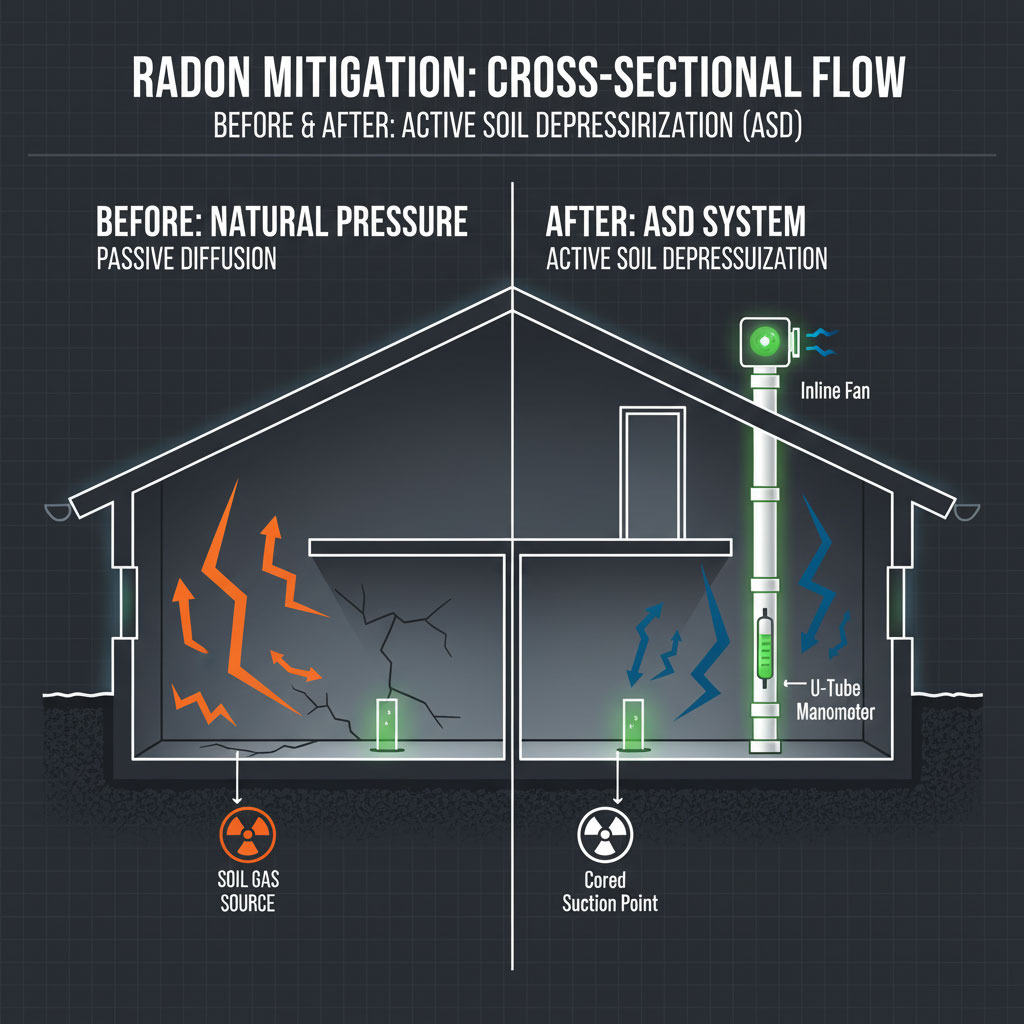
Pressure reversal dynamics. An ASD system creates a negative pressure zone beneath the foundation, drawing radon-bearing soil gas to the suction point rather than allowing it to enter the building envelope.
Critical Components of a Certified Radon System
The Suction Point
The suction point is the foundation of the system — literally and functionally. A DEP-certified installer cores a 4-inch diameter hole through the basement slab, then excavates a small pit (typically 12–18 inches deep by 12–18 inches wide) beneath the slab to create an air pocket that enhances the radial spread of the pressure field.
Suction point location is determined by diagnostic testing. The installer applies temporary suction at candidate locations while measuring pressure differentials at remote points across the slab using a micromanometer. The goal is to identify a location where a single suction point can extend measurable negative pressure to every corner of the foundation. In homes with simple rectangular footprints and clean aggregate fill beneath the slab, one suction point is often sufficient for homes up to 2,500 square feet.
Multiple suction points are required when:
- The sub-slab material is compacted clay, silt, or poorly graded fill with low gas permeability — common beneath older Pennsylvania homes, particularly in western PA where Marcellus Shale weathers to dense clay
- The foundation has interior footings, grade beams, or bearing walls that create isolated sub-slab compartments
- The building footprint exceeds 2,500 square feet or has irregular geometry (L-shaped, T-shaped)
- Diagnostic testing shows inadequate pressure field extension from a single point
In Reading's older rowhouse stock, shared party walls and segmented foundations frequently require independent suction points for each rowhouse unit. In State College's karst limestone terrain, the variable sub-slab permeability created by dissolution features can demand two or three suction points even in moderately sized homes.
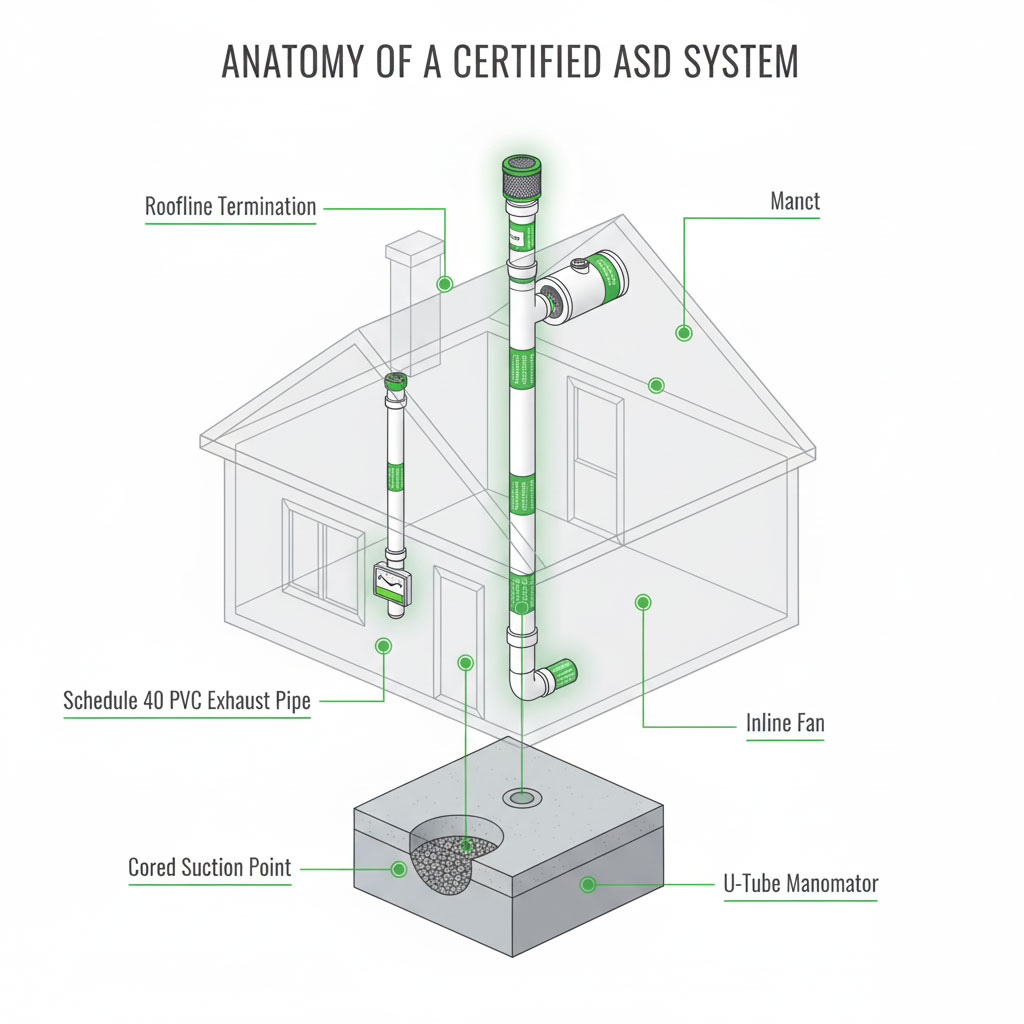
Certified system components. Every Pennsylvania-compliant ASD installation must feature a properly routed Schedule 40 PVC vent, a continuous-duty inline fan, and a U-tube manometer to confirm active suction.
The Pipe Network
ASD systems use Schedule 40 PVC pipe — typically 3-inch or 4-inch diameter — to route collected soil gas from the suction point to above the roofline. The pipe must run vertically to prevent condensate accumulation (which would block airflow) and must terminate at least 12 inches above the roof surface and 10 feet from any window, door, or other building opening.
Interior vs. exterior routing. In new construction or unfinished basements, the pipe typically runs vertically through the building interior — through closets, chases, or utility spaces — to the attic and through the roof. In existing finished basements, exterior routing along the building's exterior wall is more common to avoid disrupting interior finishes. Exterior pipes must be protected from physical damage and UV degradation and are typically painted to match the building exterior.
Condensate management. In Pennsylvania's climate, moisture condensation inside the exhaust pipe is inevitable during cold months. The pipe must be routed to allow condensate to drain back toward the suction point by gravity. No horizontal runs should create traps where water can accumulate and block airflow. A properly routed system maintains continuous downward slope from the fan to the suction point.
The Inline Fan
The fan is the active component that generates the negative pressure field. It runs continuously — 24 hours a day, 365 days a year — consuming approximately 30–90 watts depending on model and operating conditions. The fan is installed in the pipe run above the living space (typically in the attic or on the exterior wall above the roofline) so that any pipe joints downstream of the fan are under positive pressure. This means any joint leaks in the system expel air outward rather than drawing radon-bearing air into the building.
Selecting the Right Fan: High-Suction vs. High-Flow
Fan selection is an engineering decision based on sub-slab conditions, not a consumer preference. Two performance parameters define every radon fan:
Static pressure (suction) — measured in inches of water column (in. WC). This is the fan's ability to overcome resistance to airflow in the sub-slab material. Dense clay soils and compacted fill require high suction. Typical PA residential range: 0.5–2.5 in. WC.
Airflow (volume) — measured in cubic feet per minute (CFM). This is the volume of soil gas the fan can move at a given pressure. Open aggregate fill and gravel beds allow high flow rates. Tight soils restrict flow regardless of fan capacity. Typical PA residential range: 30–160 CFM.
The correct fan sits at the intersection of these two parameters for the specific sub-slab conditions at the installation site. An oversized fan wastes energy and generates unnecessary noise. An undersized fan fails to extend the pressure field across the full foundation — leaving portions of the slab unprotected.
The RadonAway RP145: Performance Profile
The RadonAway RP145 is the most widely installed residential radon fan in Pennsylvania and is the standard reference unit for most DEP-certified installers in the state.
Performance specifications:
- Maximum airflow: 160 CFM at 0.0 in. WC (free air)
- Maximum static pressure: 1.8 in. WC at 0 CFM (dead head)
- Operating range: the RP145 delivers its rated performance across typical residential sub-slab conditions (0.5–1.5 in. WC)
- Power consumption: approximately 72 watts continuous
- Noise: approximately 52 dBA at 3 feet — comparable to a quiet refrigerator
- Pipe size: 3-inch or 4-inch coupling
- Motor: thermally protected, permanently lubricated, designed for continuous outdoor operation
When the RP145 is appropriate: standard residential applications with poured-concrete basements, reasonable sub-slab aggregate, and foundation footprints under 2,500 square feet. This covers the majority of Pennsylvania single-family homes built after 1960.
When a different fan is required: homes with extremely tight sub-slab conditions (compacted clay, no aggregate), very large footprints (over 3,000 square feet), or multi-zone systems may require higher-suction fans (2.5+ in. WC) such as the RadonAway GP501 or equivalent models from Festa or Tjernlund. The installer determines this during diagnostic testing — not from catalog specs.
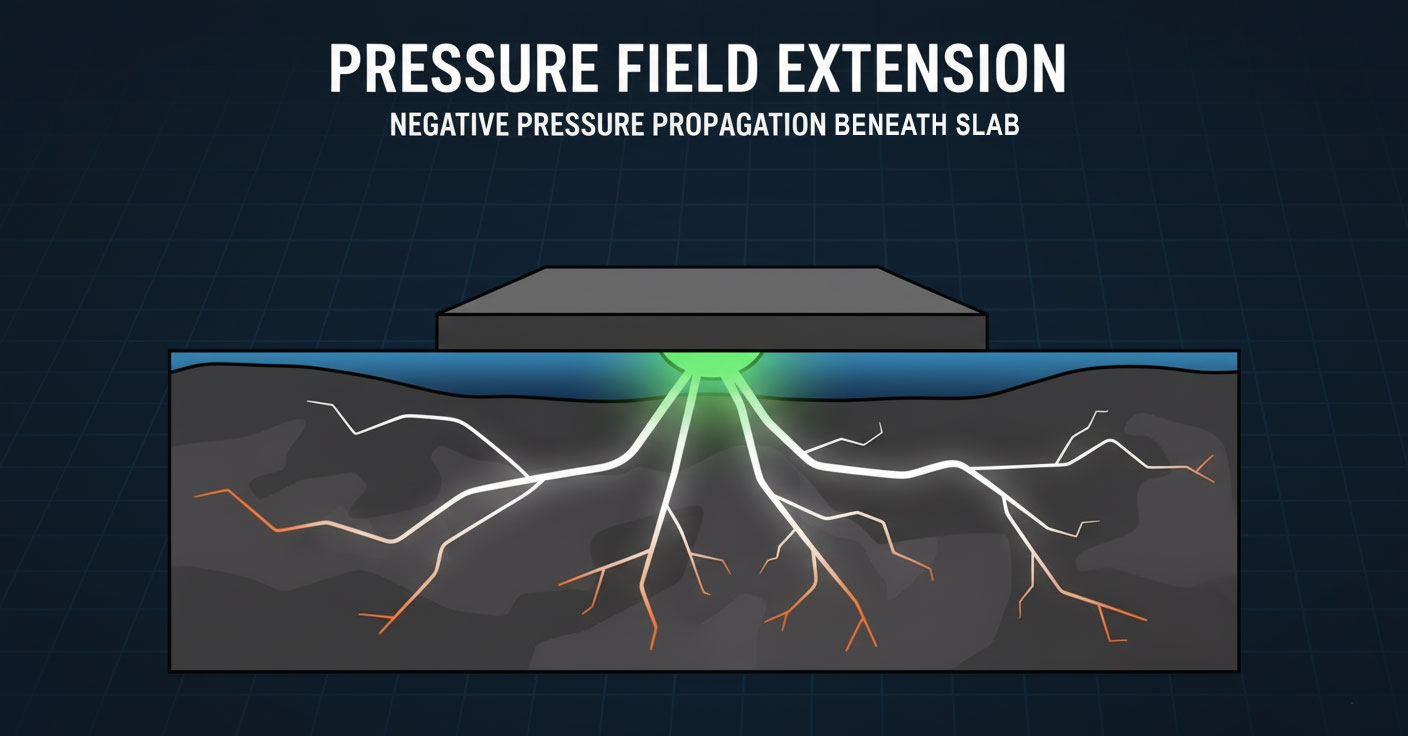
Pressure field extension. A professional ASD design ensures the negative pressure field reaches the entire foundation perimeter. Gaps in the pressure field represent unprotected zones where soil gas can still penetrate.
The U-Tube Manometer
Every certified ASD installation in Pennsylvania must include a U-tube manometer — a simple, transparent, liquid-filled tube mounted on the visible portion of the exhaust pipe. The manometer displays the pressure differential across the fan. When the system is operating normally, the liquid levels in the two columns are unequal — the difference indicates that the fan is drawing negative pressure on the sub-slab side.
What it tells you:
- Unequal liquid levels = system is operating, fan is creating suction
- Equal liquid levels = fan has failed or pipe is blocked — the system is not protecting the home
- Gradually declining differential = possible pipe obstruction, fan degradation, or sub-slab condition change — schedule service
The U-tube manometer is not a radon measurement device. It confirms system operation only. Post-installation radon testing with a calibrated detector is the only way to verify that the system is actually reducing radon to below 4.0 pCi/L.
Homeowners should check their U-tube manometer monthly. It is the single most important maintenance action for a radon mitigation system.
Integrating Smart Monitors: Continuous Radon Tracking
The U-tube manometer confirms system operation but does not measure radon concentration. For ongoing verification that indoor radon levels remain below the action level, continuous electronic monitors provide real-time data.
The Airthings View Plus
The Airthings View Plus is a consumer-grade continuous radon monitor that also tracks temperature, humidity, CO2, VOCs, and particulate matter. It provides rolling 24-hour, 7-day, and long-term average radon readings.
Why it matters for PA homeowners with ASD systems: a properly functioning ASD system can fail silently. The fan may develop a bearing issue that reduces RPM without stopping entirely. A pipe joint may develop a crack that reduces suction. Sub-slab conditions can change seasonally — wet spring soils in Pittsburgh or Erie can reduce sub-slab permeability and diminish the pressure field. A continuous monitor detects rising radon concentrations before they become sustained exposures.
Limitations: Consumer monitors like the Airthings View Plus are not certified instruments and cannot be used for DEP compliance testing or real estate transactions. Those applications require testing by individuals certified under the Radon Certification Act using calibrated equipment per ANSI-AARST protocols. The Airthings is a screening and monitoring tool for post-mitigation ongoing awareness — a complement to professional testing, not a substitute.
System Types by Foundation: What Pennsylvania Homes Need
Not every home gets a textbook ASD installation. The foundation type determines which variant of soil gas mitigation applies.
Poured-Concrete Basement (Most Common)
Standard ASD with a single suction point cored through the slab. This is the most straightforward and least expensive installation. Applicable to the majority of Pennsylvania homes built after 1960. Cost range: lower end of $843–$2,529 depending on pipe routing complexity.
Hollow Concrete-Block Foundation
Common in Reading's rowhouses and pre-1960 homes throughout southeastern PA. Block wall depressurization may be required in addition to or instead of sub-slab suction. The hollow cores of the block act as reservoirs for radon-bearing soil gas. A certified installer seals the block cores at the top course and applies suction to the wall cavity, drawing radon from the block voids before it enters living spaces. Cost: mid to upper range due to additional sealing and suction points.
Crawlspace (No Slab)
Homes with dirt-floor crawlspaces — common in Harrisburg, Lancaster, and rural central PA — require sub-membrane depressurization. A heavy-duty polyethylene sheet (6-mil minimum, 12-mil recommended) is sealed over the entire crawlspace floor and up the foundation walls. A suction point is installed beneath the membrane, and a fan creates negative pressure under the sheet, drawing soil gas out before it enters the crawlspace air. Proper sealing of the membrane at all edges, piers, and utility penetrations is critical to system performance.
Slab-on-Grade (No Basement)
Homes built on slab-on-grade foundations — less common in Pennsylvania but present in some newer developments and commercial buildings — require the suction point to be cored through the living-space slab. Pipe routing must either run through interior walls to the attic or exit through the slab and run up the exterior wall. These installations require careful coordination with the homeowner regarding suction point and pipe placement in occupied rooms. Cost: upper end of the range due to routing complexity.
Multi-Zone Systems
Large or complex homes may require multiple independent suction points, each with its own fan, serving different zones of the foundation. This is common in homes with additions, split-level construction, or foundations that span multiple geological conditions (for example, a home in Allentown where part of the foundation sits on Reading Prong granite fill and part on native karst limestone).
Overcoming Pressure Coupling in Wet Pennsylvania Soils
Pennsylvania's climate produces seasonally variable sub-slab conditions that directly affect ASD system performance. Spring snowmelt and sustained rainfall — particularly in the western Appalachian Plateau counties — can saturate sub-slab soils, dramatically reducing gas permeability. When the sub-slab aggregate or soil becomes waterlogged, the air pathways that the fan depends on are blocked. The fan continues to run but cannot extend its pressure field through saturated material.
This condition is called pressure coupling failure — the fan is running, the manometer shows some differential, but the pressure field does not extend to the building perimeter. Radon entry resumes through the unprotected portions of the slab.
Solutions:
A properly designed system anticipates seasonal moisture. The suction pit excavated beneath the core hole should be sized to function as a small sump — collecting water and allowing the fan to draw air even when surrounding soils are wet. In chronically wet sites, a dedicated sump pump may be installed in the suction pit, or the ASD system may be integrated with an existing perimeter drain tile system that provides a more reliable gas collection pathway regardless of soil moisture.
In Erie and the northern tier counties, freeze-thaw cycles create additional complexity. Ice formation in saturated sub-slab fill can block gas flow entirely for weeks. Systems in these areas must be designed with sufficient suction reserve to maintain the pressure field during partial blockage events.
PA DEP Certification: What It Means and Why It Matters
Pennsylvania law — specifically the Radon Certification Act (Act 43 of 1987) — requires that all radon testing and mitigation be performed by individuals certified by the Department of Environmental Protection. This is not optional, not waivable, and not replaceable by certifications from other states or private organizations.
What DEP certification requires
The installer must complete approved training in radon mitigation system design and installation, pass written examinations, maintain liability insurance, and submit to periodic DEP auditing. Certified individuals are assigned a license number (format: PA-LIC-XXXX-XXXX) that can be verified through the DEP's public database.
Why it matters beyond legality
A DEP-certified installer is trained to perform the diagnostic testing that determines system design — not just to drill a hole and install a fan. The diagnostic process includes sub-slab communication testing (applying suction at one point and measuring pressure response at others), visual assessment of foundation conditions, identification of radon entry pathways, and determination of the appropriate number and location of suction points. Without this diagnostic step, the installation is guesswork.
Post-Mitigation Verification: The Testing Protocol
Installing a system is not the final step. Verification testing confirms that the system actually reduces radon to below the action level.
Immediate post-mitigation test. Within 24 hours of system activation, a short-term radon test should be conducted in the lowest livable area. This provides initial confirmation that the system is working. Results should be below 4.0 pCi/L. Results between 2.0 and 4.0 pCi/L indicate the system is functional but may benefit from optimization (additional suction points, sealing of visible cracks, or fan adjustment).
Follow-up test at 12 months. A second test — ideally during the heating season when radon levels are highest — confirms sustained performance. Seasonal variation, soil condition changes, and minor system degradation can all affect long-term results.
Ongoing monitoring. The U-tube manometer should be checked monthly. A continuous electronic monitor (such as the Airthings View Plus) provides real-time trend data. If long-term average readings approach 4.0 pCi/L, professional reassessment is warranted.
For real estate transactions: 68 Pa.C.S. § 7303 requires sellers to disclose known test results and existing mitigation systems. A post-mitigation test result below 2.0 pCi/L, documented with the installer's certification, provides maximum buyer confidence.
Cost Factors for Pennsylvania ASD Systems
Statewide, residential ASD systems cost between $843 and $2,529. The range is driven by five primary variables:
Foundation type. Poured-concrete basements are cheapest. Hollow-block foundations add $200–$500 for block wall sealing and depressurization. Crawlspace sub-membrane systems add $300–$700 for membrane materials and sealing labor. Stone foundations (found in pre-1920 homes in Reading, Bethlehem, and Lancaster) are the most complex and expensive.
Number of suction points. Each additional suction point adds $200–$400 in materials and labor. Homes on low-permeability soils or with complex footprints may need 2–4 suction points. Homes on clean aggregate with simple footprints typically need one.
Pipe routing. Interior routing through unfinished spaces is cheapest. Exterior routing adds $100–$300 for pipe, fittings, and fasteners. Routing through finished interior spaces (requiring drywall repair) adds $200–$500.
Fan selection. Standard residential fans (RadonAway RP145 class) cost $150–$250 installed. High-performance fans for difficult sub-slab conditions cost $250–$400.
Geography. Costs tend to be higher in the Philadelphia metro and Lehigh Valley (higher labor rates, more complex geology) and lower in western and north-central PA. State College installations can be expensive due to karst-related complexity despite lower labor rates.
Get quotes from at least three DEP-certified contractors for your specific property. The cheapest bid is not always the best — diagnostic testing quality and system design matter more than material cost.
Connecting you with DEP-certified professionals across Pennsylvania. We are an independent resource and do not perform testing or mitigation.
View Certified Providers →
Related Resources
- Pennsylvania Radon Compliance 2026: Law & Testing Standards — regulatory requirements and real estate disclosure law
- The Geology of Indoor Radon: Why the Reading Prong and Marcellus Shale Drive PA Risk — formation-level geology behind Pennsylvania's radon crisis
- Radon Mitigation in Reading, PA — city-level analysis of the Reading Prong epicenter
Watch: Why 40% of Pennsylvania Homes Fail Radon Tests
PA Radon Hub is an independent informational resource. We do not perform radon testing or mitigation. We connect Pennsylvania property owners and institutions with independent, DEP-certified radon professionals. Always verify contractor certifications through the PA Department of Environmental Protection before hiring. EPA action level: 4.0 pCi/L. Costs and availability vary by contractor and property conditions.