Radon Mitigation in Reading, PA: Why Berks County Is the Epicenter of Pennsylvania's Radon Crisis
Reading sits on the Reading Prong — the densest uranium-bearing granitic bedrock in the eastern United States. 58.7% of tested homes in Berks County exceed EPA's 4.0 pCi/L action level. Average mitigation cost: $1,050–$2,529 for active sub-slab depressurization. All work must be performed by DEP-certified professionals.
Why Reading, PA Has the Worst Radon in the Eastern United States
Reading doesn't just have a radon problem — it sits on the geological formation that defines the radon problem in North America. The city and surrounding Berks County are built directly atop the Reading Prong, a belt of Precambrian granite and gneiss that stretches from eastern Pennsylvania into New Jersey and southern New York. This formation contains some of the highest naturally occurring concentrations of uranium-238 in the eastern hemisphere.
The decay chain is straightforward: uranium-238 in the bedrock decays to radium-226, which decays to radon-222 — a colorless, odorless radioactive gas. In Reading, the fractured granite bedrock provides direct migration pathways from deep soil into building foundations. The result: 58.7% of tested Reading homes exceed EPA's 4.0 pCi/L action level, and the citywide average tested level is 5.1 pCi/L — already above the threshold where the EPA recommends mitigation.
This isn't a marginal risk. The EPA classifies all of Berks County as Zone 1 (highest radon potential). For context, the national average indoor radon level is approximately 1.3 pCi/L. Reading homes test at nearly four times that.
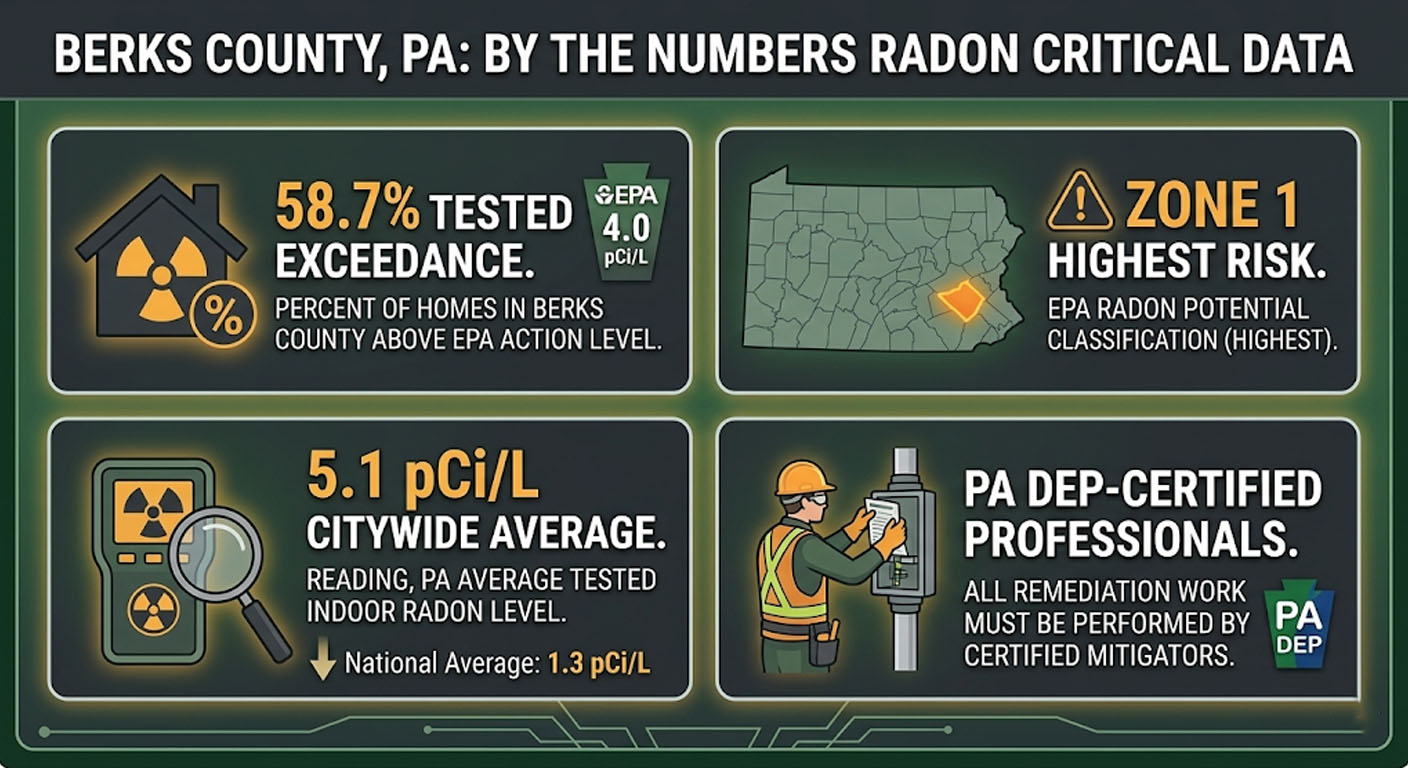
Radon risk profile for Berks County, PA. With 58.7% of homes exceeding the 4.0 pCi/L EPA action level, Reading properties consistently test above the national average.
The Stanley Watras Connection
Pennsylvania's role as the epicenter of residential radon awareness traces directly to the Reading Prong. In 1984, Stanley Watras — a construction engineer at the Limerick Generating Station in nearby Montgomery County — triggered radiation alarms at the nuclear plant before it had been fueled. The source was radon in his home, built on the same Reading Prong geology. His basement tested at over 2,700 pCi/L, roughly 675 times the EPA action level. The Watras case led to the EPA's first nationwide radon survey and directly catalyzed the passage of Pennsylvania's Radon Certification Act (Act 43 of 1987).
Reading sits at the geological center of this same formation — closer to the uranium-dense core of the Reading Prong than Limerick, with older and more permeable building stock.
Radon Risk in Reading's Neighborhoods
Not all of Reading faces identical risk, though the floor is high everywhere due to underlying geology.
Older Rowhouse Districts (Highest Risk)
Reading's historic rowhouse neighborhoods — including areas of Centre Park, Hampden Heights, and the blocks surrounding Penn Street — feature construction characteristics that amplify radon intrusion. Hollow concrete-block foundations, common in rowhouses built between 1900 and 1960, allow soil gas to accumulate within the block voids and seep through mortar joints. Party walls shared between attached units do not prevent lateral soil gas migration. Many of these homes lack modern vapor barriers beneath their basement slabs.
For these properties, standard active sub-slab depressurization (ASD) may need to be supplemented with block wall depressurization — a technique where suction is applied directly to the hollow cores of the foundation block. This adds complexity and cost to the installation.
Suburban and Newer Construction
Homes in West Reading, Wyomissing, and Shillington — built on the same Reading Prong geology but with modern poured-concrete foundations and sealed vapor barriers — are still Zone 1 properties with elevated radon risk, but they respond more predictably to standard ASD installation. A single suction point with a RadonAway RP145 inline fan is typically sufficient for homes under 2,500 square feet with poured-concrete basement slabs.
Slab-on-Grade Properties
A smaller portion of Reading's housing stock uses slab-on-grade construction. These properties present different mitigation challenges — the suction point must be cored through the living-space slab, and routing the PVC exhaust pipe to the roofline requires interior or exterior chase construction. Costs for slab-on-grade mitigation in Reading fall at the upper end of the $1,050–$2,529 range.
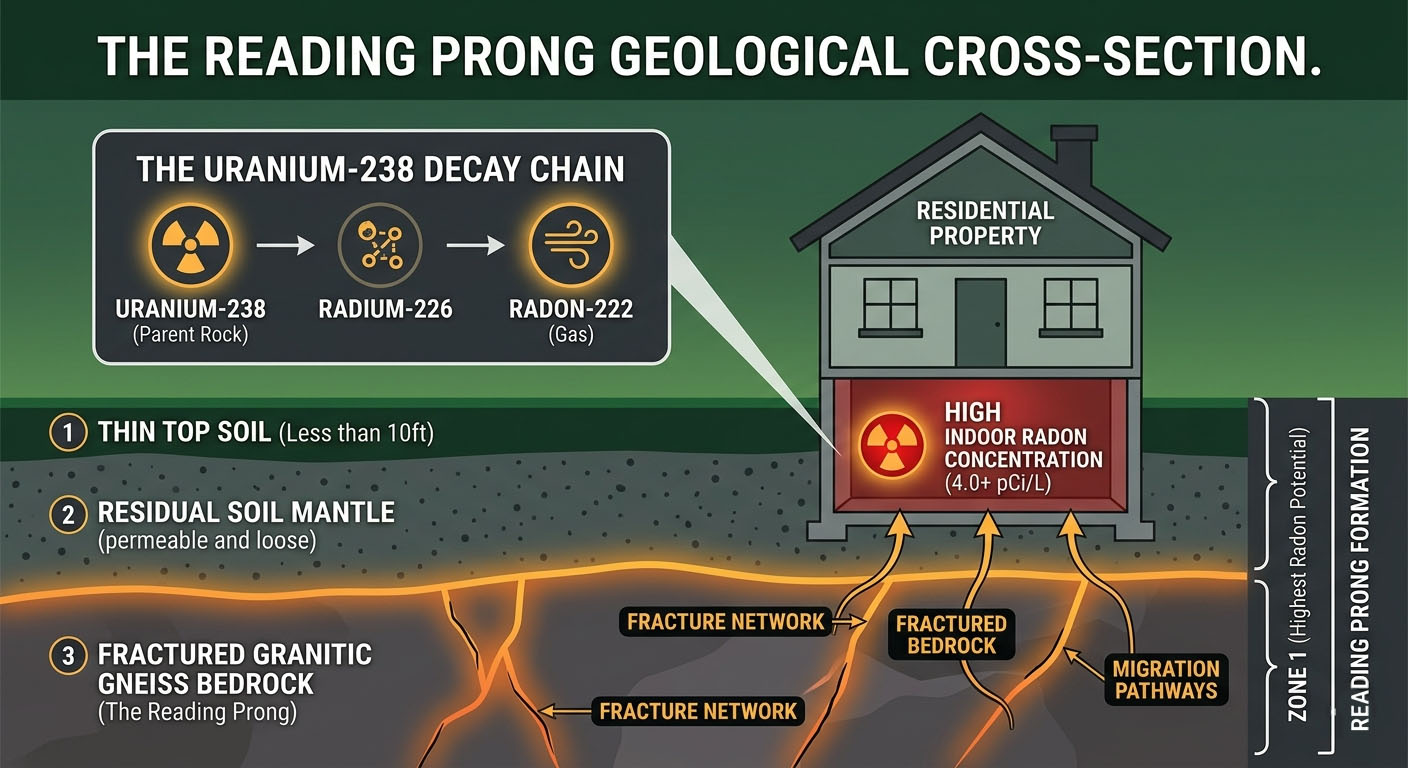
Radon-222 migration pathway from Reading Prong bedrock to residential foundations. Fractured Precambrian granite and thin soil cover in Berks County allow direct gas transport into homes.
What Radon Mitigation Costs in Reading, PA
The typical cost for a professionally installed active sub-slab depressurization system in Reading ranges from $1,050 to $2,529, depending on three primary factors:
Foundation type. Poured-concrete basements are the simplest and cheapest to mitigate. Hollow concrete-block foundations require additional suction points or block wall depressurization. Stone foundations (found in some pre-1920 homes in Reading) are the most complex and expensive.
Home size and slab area. Homes under 1,500 square feet typically need one suction point. Homes between 1,500 and 3,000 square feet may require two. Above 3,000 square feet, diagnostic testing is needed to determine the number of suction points required to achieve adequate pressure field extension across the entire sub-slab area.
System type. The three systems used in Reading are:
- Active sub-slab depressurization (ASD): The standard and most common. A 3- or 4-inch PVC pipe runs from a cored suction point in the basement slab, through the building, to above the roofline. An inline fan (such as the RadonAway RP145, rated at 160 CFM at 0.0" water column) runs continuously to maintain negative pressure beneath the slab.
- Drain tile depressurization: Used when existing perimeter drain tile systems are present. Suction is applied to the drain tile loop rather than through a dedicated core hole.
- Block wall depressurization: Specific to hollow-block foundations. Suction is applied to the block cores via sealed access points, drawing radon from the wall cavities before it enters living spaces.
All systems must be installed by PA DEP-certified professionals under the Radon Certification Act. Post-installation testing must confirm levels below 4.0 pCi/L.
Connecting you with DEP-certified professionals serving Berks County. We are an independent resource and do not perform testing or mitigation.
View Reading Providers →
SB 760 and Berks County Schools
Pennsylvania Senate Bill 760, introduced May 22, 2025, would mandate radon testing in all public school buildings beginning in the 2026-2027 school year if enacted. As of 2026 the bill remains in committee. The bill's proposed provisions for Berks County schools:
Testing scope. If enacted, every existing school building would be required to be tested for radon. Initial testing would be required to occur within one year of the law's effective date. New school buildings would be required to be constructed using radon-resistant techniques per ANSI-AARST CC-1000.
Testing protocol. Under the proposed framework, all testing would be required to follow ANSI-AARST MA-MFLB (Protocol for Conducting Measurements of Radon and Radon Decay Products in Multifamily, School, Commercial and Mixed-Use Buildings) and to be performed by individuals certified under the Radon Certification Act.
Mitigation requirement. Under the proposed framework, if any room or occupied area in a school building tests at or above 4.0 pCi/L, the building would be required to be mitigated and retested until levels fall below 4.0 pCi/L. Mitigation system installations would be required to be completed within six months of confirmatory testing. Systems would be required to comply with ANSI-AARST SGM-MFLB standards.
Retesting schedule. Under the proposed framework, buildings testing below 4.0 pCi/L would be required to retest every five years or after major structural, foundational, or HVAC renovations. Buildings testing at or above 4.0 pCi/L would be required to retest every two years.
Public reporting. Under the proposed framework, results would be required to be reported within 60 days to the school governing body at a public meeting, communicated to parents' organizations and employee organizations, posted on the district's website and social media, and submitted to the DEP Bureau of Radiation Protection, the State Board of Education, the Department of Education, and the county health department.
Given Berks County's Zone 1 EPA classification and the Reading School District's building stock — much of which predates modern radon-resistant construction standards — if SB 760 is enacted as introduced, testing and compliance requirements would apply to schools and (where specified) other regulated facilities. Final scope, thresholds, and deadlines remain pending committee action. For more on the legislation, see our Pennsylvania Radon Compliance 2026 guide.
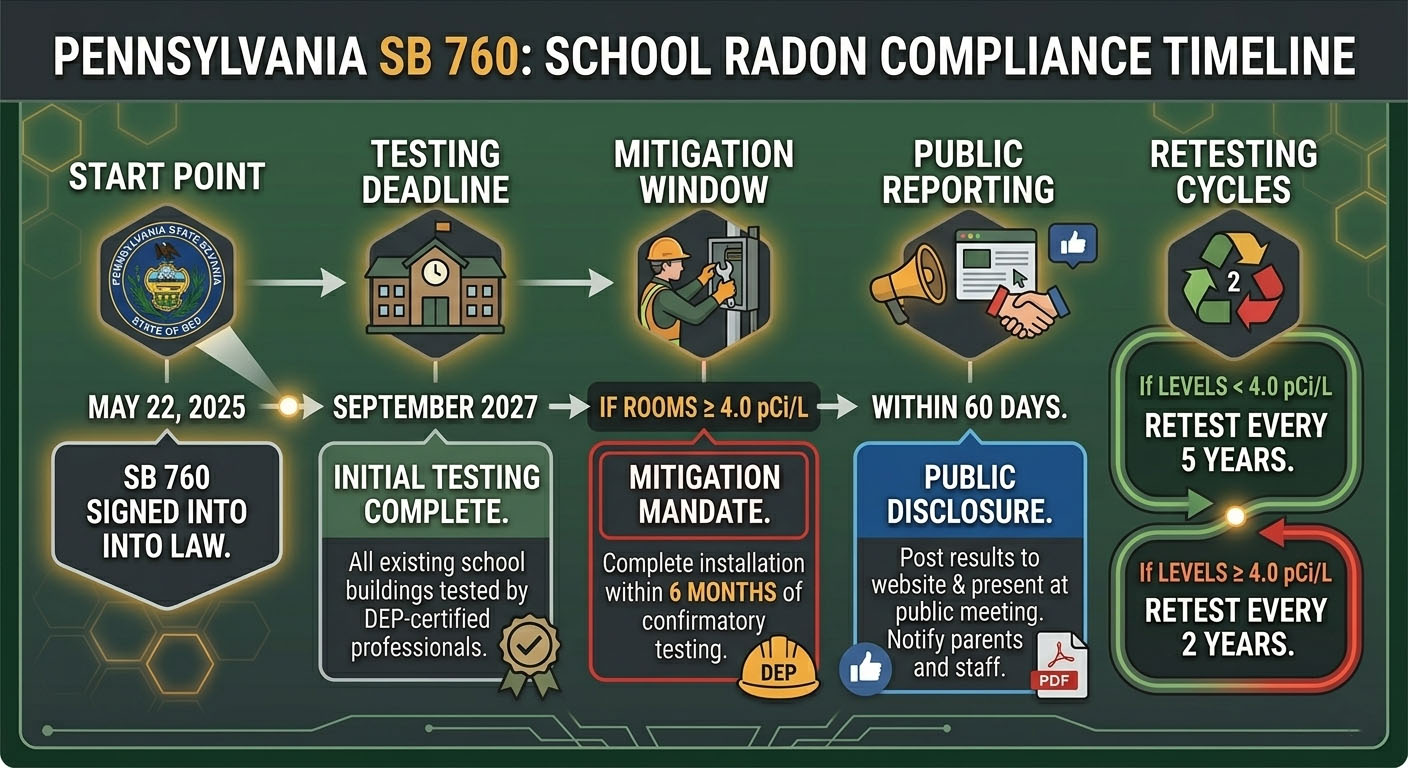
Proposed timeline under Pennsylvania Senate Bill 760 if enacted. If passed, all public school buildings would be required to complete testing by the 2026–2027 academic year, with mitigation required within six months of any confirmed result at or above 4.0 pCi/L. As of 2026 the bill remains in committee.
Real Estate and Radon in Reading
Berks County's real estate market intersects with radon in specific, legally relevant ways.
Pennsylvania's Real Estate Seller Disclosure Law (68 Pa.C.S. § 7301 et seq., with the seller's duty at § 7303) requires sellers to disclose known radon test results and any radon mitigation systems installed in the property. This is not a testing mandate — sellers are not required to test — but they must disclose results if testing has been performed.
In practice, nearly all residential transactions in Berks County include radon contingencies. At a median home price of $195,000, buyers are dealing with properties built on Zone 1 geology where 58.7% of homes exceed the EPA action level. FHA and VA lenders in the county increasingly require radon testing as a condition of financing.
For buyers: insist on a 48-hour short-term radon test during the inspection period. If results exceed 4.0 pCi/L, negotiate mitigation costs ($1,050–$2,529) into the purchase agreement. An installed and verified ASD system adds measurable value to a Reading-area property — it eliminates a known risk on a Zone 1 lot.
For sellers: proactive testing and mitigation before listing removes the most common contingency failure point in Berks County transactions. A post-mitigation test result below 2.0 pCi/L, combined with a visible ASD system and functioning U-tube manometer, signals to buyers that the property has been properly addressed.
How to Test for Radon in Reading
Testing is the only way to determine radon levels — the gas is colorless and odorless. Two approaches:
Short-term testing (48–96 hours). Charcoal canisters or continuous radon monitors (CRMs) placed in the lowest livable floor of the home. Closed-house conditions must be maintained for 12 hours before and during testing per ANSI-AARST protocols. Short-term tests provide a screening result. Cost: $15–$30 for a DIY charcoal kit, $150–$250 for a certified professional with CRM equipment.
Long-term testing (90+ days). Alpha-track detectors or electronic continuous monitors (such as the Airthings View Plus) provide a more accurate annual average. Long-term results are more representative of actual exposure, particularly given seasonal fluctuation — radon levels in Reading typically peak in winter when homes are sealed and the stack effect is strongest.
For real estate transactions, short-term CRM testing by a DEP-certified tester is standard. For personal health assessment, long-term monitoring is more reliable.
The Reading Prong: Geological Context
The Reading Prong is a physiographic section of the New England Upland province, composed primarily of Precambrian granitic gneiss, quartzite, and metamorphosed sedimentary rocks. The formation extends from southeastern Pennsylvania through northern New Jersey to the Hudson Highlands of New York.
Within Berks County, the bedrock is characterized by high concentrations of accessory minerals containing uranium and thorium. The decay of uranium-238 through its daughter products (thorium-234 → protactinium-234 → uranium-234 → thorium-230 → radium-226 → radon-222) produces radon gas continuously within the rock matrix.
What makes the Reading Prong particularly problematic for indoor radon is the combination of:
High uranium content in the parent rock. The granitic gneiss of the Reading Prong contains significantly elevated uranium concentrations compared to the national average for crystalline basement rock.
Fractured bedrock. The Reading Prong has been subjected to multiple orogenic events (Grenville, Taconic, Acadian, Alleghenian), producing pervasive fracture networks that serve as high-permeability conduits for radon gas migration from depth to the soil surface.
Thin soil cover. In many areas of Reading and Berks County, the residual soil mantle overlying the bedrock is thin (less than 10 feet), providing minimal attenuation of radon flux from the rock surface to building foundations.
Permeable glacial and alluvial deposits. Where thicker soils exist, they are often composed of coarse glacial till or alluvial gravels with high gas permeability, offering little resistance to radon transport.
This geological combination — uranium-rich source rock, fractured migration pathways, thin soils, permeable overburden — produces the highest ambient radon fluxes in the eastern United States and directly explains why 58.7% of tested Reading homes exceed the EPA action level.
For a deeper technical discussion of how Pennsylvania's geology drives indoor radon concentrations statewide, see: The Geology of Indoor Radon: Why the Reading Prong and Marcellus Shale Drive PA Risk.
Nearby Cities: Regional Radon Context
Reading's geology doesn't stop at the city limits. The Reading Prong and associated formations affect the entire region:
- Allentown — Lehigh County, Zone 1. The Lehigh Valley's limestone and dolomite bedrock creates additional radon pathways through karst dissolution features.
- Pottstown — Montgomery County, Zone 1. Sits on the southeastern extension of the Reading Prong, sharing Reading's granitic gneiss geology.
- Kutztown — Berks County, Zone 1. University town 20 miles northeast of Reading, same Reading Prong geology, elevated student rental radon exposure concerns.
- Harrisburg — Dauphin County, Zone 1. Great Valley carbonate bedrock creates different but equally high-risk radon pathways.
- Philadelphia — Philadelphia County, Zone 1. Piedmont geology transitions from Reading Prong influence; lower average levels but still 42.3% exceedance rate.
- Hamburg — Berks County, Zone 1. Northern Berks borough on the Prong's upper corridor; same uranium-bearing granitic geology as Reading.
- Fleetwood — Berks County, Zone 1. Borough in the Reading Prong's northeastern Berks extent; elevated exceedance rates consistent with the formation.
PA Radon Hub is an independent informational resource. We do not perform radon testing or mitigation. We connect Pennsylvania property owners and institutions with independent, DEP-certified radon professionals. Always verify contractor certifications through the PA Department of Environmental Protection before hiring. EPA action level: 4.0 pCi/L. Costs and availability vary by contractor and property conditions.